
NITN | @notintownlive | 16 Jan 2018, 10:43 am
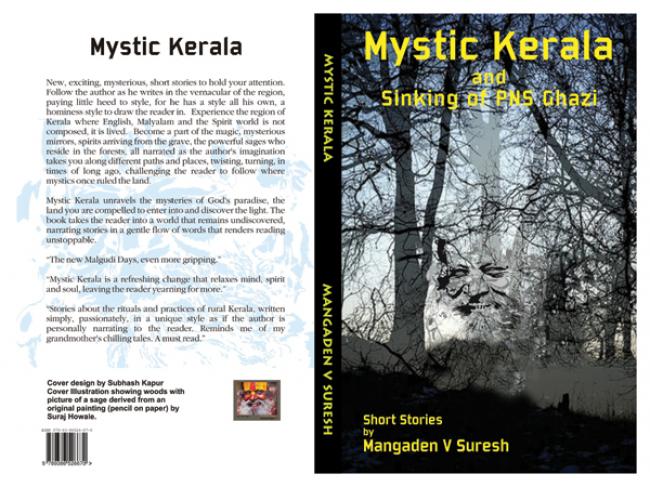
Mangaden V Suresh talks about what inspired him to write Mystic Kerala, published by Power Publishers
How did you become involved with the subject or the theme of your book?
It was my grandmother who opened a window for me when I was a child, in Pandakkal, a small village in Tellicherry, North Malabar, Kerala.
Ancient Kerala is a mystic blend of esoteric science, astrology, signs of nature, and the people knew how to interpret the sounds in the forest. It was exotic to walk with her into the forests and absorb the mysteries of nature. These do not stand the logic of modern science, yet they were amazingly accurate in their prediction, They could foresee the future, and interpret the signs of nature, what they call 'Nimitham'.
My grandmother was a scholar in Sanskrit and Malayalam. Being her favorite grandson, she often walked me deep into the forests to show old and mysterious temples, teaching me to read the forest signs, the signs given out by the birds, forest animals and the insects. Her interpretation was not only amazing but also infallible.
How long have you been writing?
I have been writing only for the last four to five years.
Do you write more by logic or intuition,or some combination of the two. Summarize your writing process.
I have been writing more by intuition. Early in the morning, when I sit in the garden, and watch the wonders of nature unfold, a thought flashes in my mind, and quickly transforms itself into a story.
Once I felt there was dead body behind the mirror. The story developed of its own; it was a story that captivated my friends. On one occasion, as I descended the stairs, I saw a hand float in the air. It became a powerful story.
A relative once told me about his meeting an old man and a girl on a train. The old man asked my relative to marry his girl, but he declined. Later, he saw the same girl at his home come out of the bathroom and walk out through the closed door. He never lived alone in that house. His fear and apprehension were true.
.jpg)
Where did your love of books/storytelling/reading come from?
I have been reading books since my childhood. Dostoevsky and Nikolai Gogol's "Overcoat" had a tremendous influence on me.
Rabindranath Tagore, Sarath Chandra, Munshi Prem Chandra were my world, I read them again and again, as also the inimitable R K Narayan.
I also liked the style of Malayali writer Basheer.
Can you share some of the stories about people you met while researching this book?
I did not do any research. I did meet people, who recounted strange encounters. I did meet priests in the temples in the forests and astrologers who were amazingly accurate In their predictions, everything seem to be ordained. It is written in your stars.
Most of the stories were based on my recollection of narratives during travels into the forests with my grandmother. Later, before starting to write, I travelled again some of those paths, recollecting her tales and reading the signs in the forests. I met several elderly people who guided me in the ancient history of Kerala, met priests and astrologers, and committed all that I saw and heard into my memory.
What makes your book stand out from the crowd?
What makes my book stand out is the style and pace of the narrative. I write as I heard the stories narrated to me, and imagine the readers listening to my stories with rapt attention as if they as they sit cross-legged like children before their grandmothers, listening to her tales. I also retain the flavour of the local people, both in speech and character. The flow is easy and simple to follow, with no adult content, making it worthwhile for people of all ages to read and enjoy the thrilling stories.
My friends tell me that once they start reading a story, they cannot put it down till they reach the end. The end is usually dramatic. Once they complete a story, they get hooked, and they want more. What stands out is the language, it goes straight to the heart. The reader feels enthralled as if he is living a real life incident. It may not follow a traditional script; the events unfold at a rapid pace, the reader cannot foresee the many sudden twists and turns in the story, and once started, the curiosity is so aroused he is compelled to continue till the end. Once there, I see a smile on the reader's face, a smile, a sign of contentment. That, precisely, is the objective of this book.
- Sundeep Bhutoria brings Bengal’s Mahalaya to the nation in Hindi – Mahishasur Mardini ki Gatha
- VeeCycle Works Signs MoU with AP Govt for Rs 150 Cr Recycling Project in Visakhapatnam
- Kolkata culturist Sundeep Bhutoria inaugurates India National Stand at Frankfurt Book Fair 2026
- Where governments stop, institutions begin: Culture Minister Shekhawat salutes Prabha Khaitan Foundation
- National Award-winning ‘Ramnami’ puts spotlight on community behind Chaltabagan’s ‘Nishan’ theme
- Thiagarajar Polytechnic College receives Education Excellence Award for the fifth time
- Sona College of Technology's 25th graduation day: 1,325 students receive BE, BTech, ME, MCA, MBA and PhD degrees
- ‘We are the worst storytellers’: Suhel Seth on India’s failure to market itself at 'Kitaab' book launch
- Sona College of Technology welcomes 2,400 freshers to UG, PG programmes
- ‘Children shouldn’t carry the burden’: Social activist Sundeep Bhutoria urges Centre to enforce 10% school bag rule
IndiGo will introduce daily non-stop flights to Udaipur from Noida International Airport and Navi Mumbai International Airport, starting October 25 and November 15, 2026 respectively.

Etihad Airways and Nigerian carrier Ibom Air have signed an interline agreement that will allow passengers travelling with Etihad to connect beyond Lagos and Accra to five cities in Nigeria on a single ticket.

Tata Group-owned Air India on Monday announced that guests flying during Navratri will be served specially curated festive meals onboard its flights and at its lounges in Delhi and Mumbai.