
NITN 14 Jun 2017, 08:03 am
On one hand, the implementation of GST will be a huge exercise for the business houses and the financial institutions while the general public will take time to adjust to the change in tax categories and resulting price changes of goods and services.
Therefore, tax consultants and business houses as well as various media have been discussing GST with much vigour and urgency.
I know that once GST comes into play, our financial situations are going to be majorly affected.
But for a layman like me, it is difficult to gauge the ramifications of GST in its entirety.
Thus we wait for the introduction of GST with apprehension.
In such a scenario, a book that discusses GST in detail is a welcome thing.
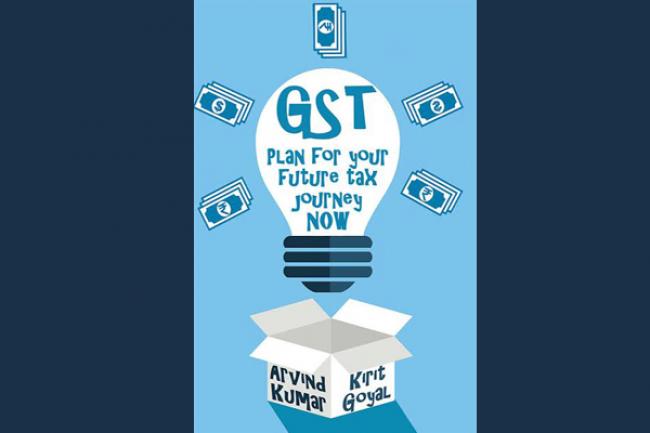
Thus “GST Plan Your Future Tax Journey Now” by Arvind Kumar and Kirit Goyal, from Power Publishers, is a timely publication.
The book contains in-depth discussions about the impact of GST on various sectors like the domestic sector and the trade sector.
The first question that arose in our minds when we heard that GST is going to be implemented soon, was how our financial situation would be affected.
GST is supposed to integrate the various indirect taxes levied on the distribution and transportation of goods and services.
It is supposed to decrease the cascading effect of taxes and bring in uniformity in sales tax across all the states and union territories of the country.
In short, if GST really does come into play, then the tax burden on consumers is supposed to reduce in many cases and yet the revenue collection on a national level is expected to become easier and the national GDP is also supposed to increase.
The best thing that the authors of “GST Plan Your Future Tax Journey Now” have done is that they have studied the GST model of other nations who have a similar federal structure as India.
The problems and benefits that countries like Canada, Australia and Brazil have faced with the implementation of GST have been discussed vividly.
This approach will help readers to gauge the potential problems and benefits that we might face when GST comes into play in India.
Another stand out feature of this book is that the authors have discussed the various important points that have not been mentioned in the First Discussion Paper of GST (this paper has been included in the book).
For example, taxes on essential commodities like petrol, electricity have not been included in GST.
GST is supposed to integrate all the state level taxation and yet there would be some items for which the states can levy separate taxes. This dilutes the very idea of GST.
There are many many glaring loopholes in the proposed GST model the book points out.
It is worth reading the book just to make ourselves aware about these problem areas.
However, this book does not stop at criticizing the proposed model.
The authors have also offered some solutions as well.
Since GST is going to have a lasting impact on our lives, it is our responsibility, as educated and aware citizens, to update ourselves on this subject.
And this book is a perfect answer to that.
(Reviewed By Priya Das)
- Manicktala Chaltabagan Lohapatty Durga Puja Committee wins numerous Awards as ‘Nishan’ theme captures hearts
- Bengal Guv R. N. Ravi inaugurates Chaltabagan Lohapatty Durga Puja’s 84th edition ‘Nishan — The Mark’
- Sundeep Bhutoria brings Bengal’s Mahalaya to the nation in Hindi – Mahishasur Mardini ki Gatha
- VeeCycle Works Signs MoU with AP Govt for Rs 150 Cr Recycling Project in Visakhapatnam
- Kolkata culturist Sundeep Bhutoria inaugurates India National Stand at Frankfurt Book Fair 2026
- Where governments stop, institutions begin: Culture Minister Shekhawat salutes Prabha Khaitan Foundation
- National Award-winning ‘Ramnami’ puts spotlight on community behind Chaltabagan’s ‘Nishan’ theme
- Thiagarajar Polytechnic College receives Education Excellence Award for the fifth time
- Sona College of Technology's 25th graduation day: 1,325 students receive BE, BTech, ME, MCA, MBA and PhD degrees
- ‘We are the worst storytellers’: Suhel Seth on India’s failure to market itself at 'Kitaab' book launch


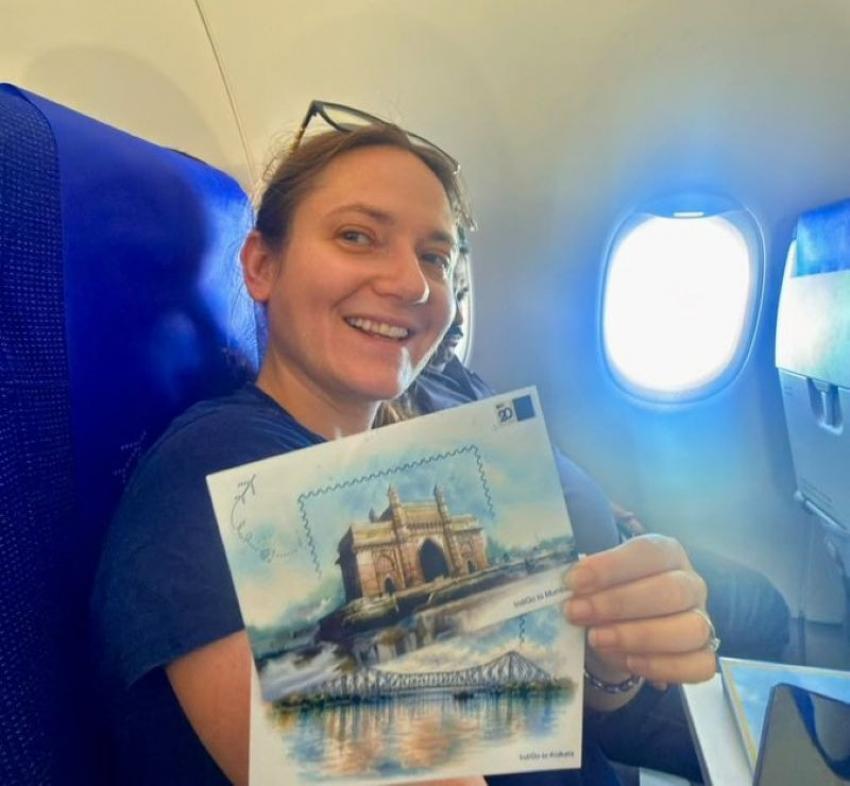
In an effort to revive the joy of handwritten communication in an increasingly digital world, the Department of Posts under the Ministry of Communications, in collaboration with IndiGo, organised a unique Digital Detox Campaign on October 12, observed as Philately Day during the ongoing National Postal Week celebrations from October 9 to 15.

Singapore Airlines (SIA) is upgrading its in-flight entertainment system, KrisWorld, with new display technology, audio features, personalisation tools and high-speed internet connectivity. The changes are intended to give passengers more control over their entertainment and how they use their time on board.

Air India will launch non-stop flights between Delhi and Osaka’s Kansai International Airport on 2 February 2027, becoming the only airline to operate on the route. The airline will run four flights a week between the Indian capital and Osaka, Japan’s second-largest metropolitan area, using Boeing 787-8 aircraft.