
NITN | @notintownlive | 13 Jun 2026, 12:00 am
 DigiYatra
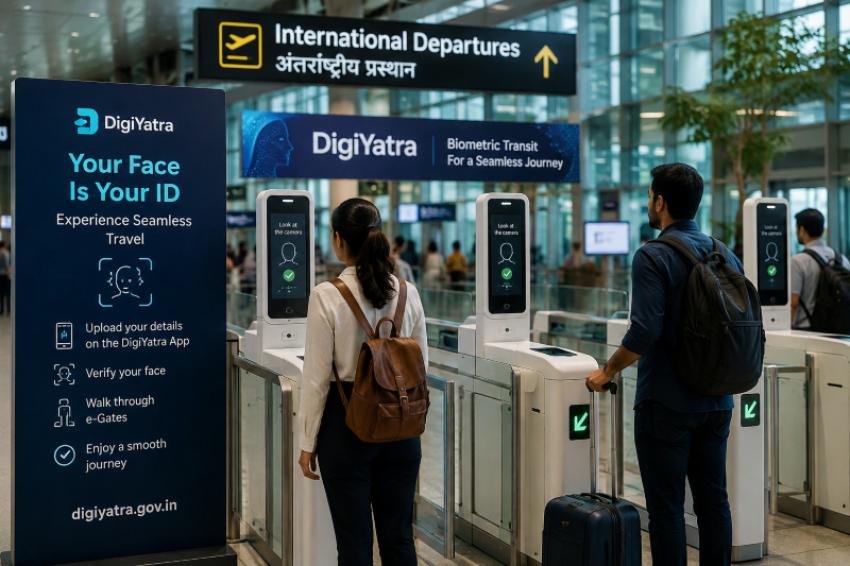
DigiYatra transit system aims to reduce queues at key airport checkpoints. Photo: generated by ChatGPT
The Ministry of Civil Aviation has introduced mandatory DigiYatra biometric transit for Indian passengers travelling internationally through four major airports – Delhi, Mumbai, Bengaluru, and Hyderabad. The new system came into effect on June 1, 2026, and is aimed at making passenger movement faster and more seamless through the use of facial recognition technology.
Under DigiYatra, a passenger's face acts as a digital identity token, reducing the need for repeated document checks at various stages of the airport journey. Instead of repeatedly scanning boarding passes, travellers can move through designated checkpoints using biometric verification.
How the DigiYatra transit process works
- Passengers are required to upload an Aadhaar-verified selfie and their boarding pass to the DigiYatra app at least 48 hours before departure.
- There is, however, an important catch. Since a boarding pass is needed for the process, travellers will first have to secure a confirmed seat with their airline. In many cases, this may require paying an additional fee for seat selection before the boarding pass can be generated and uploaded.
- Upon arrival at Delhi, Mumbai, Bengaluru, or Hyderabad airports, passengers can use dedicated biometric e-gates.
- Facial recognition cameras will match the traveller's live image with an encrypted biometric template stored in the DigiYatra cloud.
- Once the identity is successfully verified, access to the international transit corridor will be granted automatically.
- Passengers will no longer need to repeatedly scan paper boarding passes during the transit process.
- The system is expected to speed up passenger movement and reduce congestion at key checkpoints within the airport.
The move marks another step in India's push towards paperless and technology-driven air travel. By replacing multiple rounds of manual verification with a single biometric identity, authorities hope to streamline the transit experience at some of the country's busiest airports.
For Indian travellers using these airports for international journeys, understanding the DigiYatra process in advance could help avoid last-minute confusion and ensure a smoother transit experience.
- Emirates expands in Japan with new Travel Store in Tokyo and additional Narita flights
- IndiGo passengers get a surprise at 30,000 feet: Here's what they were asked to do
- Riyadh Airport shut until October 17 after deadly Houthi attacks
- Navi Mumbai Airport’s aviation push: TajSATS facility ready to handle rising passenger demand
- Malaysia stays visa-free for Indians through 2026, but entry rules still apply
- Singapore introduces tougher penalties for disruptive behaviour on public transport
- Etihad Rail launches passenger service between Dubai and Abu Dhabi
- New Zealand moves most visitor visa applications to enhanced online system
- Indian passport rules changed: New validity, fees for children and adults explained
- Azerbaijan makes F1 travel easier for Indian fans with visa on arrival



Air India will launch non-stop flights between Delhi and Osaka’s Kansai International Airport on 2 February 2027, becoming the only airline to operate on the route. The airline will run four flights a week between the Indian capital and Osaka, Japan’s second-largest metropolitan area, using Boeing 787-8 aircraft.

IndiGo will introduce daily non-stop flights to Udaipur from Noida International Airport and Navi Mumbai International Airport, starting October 25 and November 15, 2026 respectively.

Etihad Airways and Nigerian carrier Ibom Air have signed an interline agreement that will allow passengers travelling with Etihad to connect beyond Lagos and Accra to five cities in Nigeria on a single ticket.