
News
India
Kolkata: Narula Institute of Technology organizes 'Evolution 2017: School Teachers' Meet'
27 Jan 2017, 12:40 pm
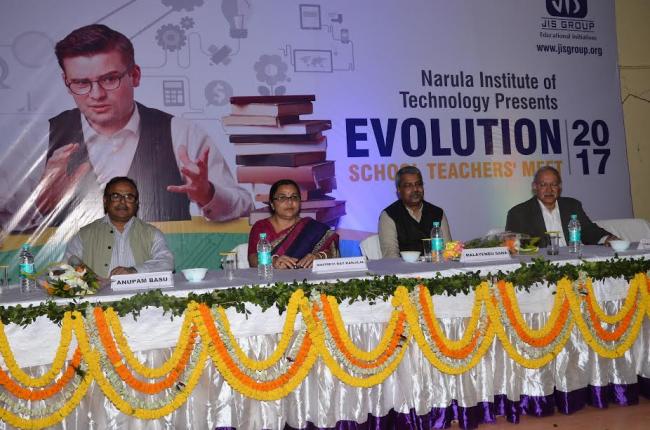
Kolkata, Jan 27 (NITN): : Narula Institute of Technology, under the aegis of JIS Group Educational Initiatives, organised a one-day workshop titled ‘Evolution 2017- School Teachers’ Meet’ on 25 January, 2017, which focused on the Paradigm Shift in School Education.
The Evolution 2017 intended to bridge the gap between urban and marginalised schools. Around 102 teachers from fifty-three schools actively participated in this event. Some of the schools which participated were Ramkrishna Sarada Mission, Sister Nivedita Girls' School, Pearls of God, Baranagar Rajkumari Memorial Girls' High School, Hariyana Vidya Mandir, St.Augustine Day School and many more across the entire state. The conglomeration of teachers extended from Kolkata, Howrah, Hooghly, Midnapore, Nadia, and North 24 Parganas.
The session was inaugurated by Prof. (Dr.) Malayendu Saha (Chairman West Bengal Joint Entrance Examination Board) who spoke about the changing trends in education. The other resource persons were Prof (Dr) Anupam Basu (Chairman, Center for Educational Technology & Professor, Dept. of Computer Science & Engineering - Indian Institute of Technology, Kharagpur), Mr. Gautam Chakrabarty (Management Trainer & Consultant), Swami Vedatitananda, Ramakrishna Mission Shilpamandira, Belur.
Prof. (Dr) Anupam Basu, throwing light on the Educational Reforms & Teacher Training, said, “Formative Assessment and Summative Assessment are very important factors to identify and develop the cognitive ability of a student. If a student is scoring less marks, then we need to assess them from the microscopic level to know where the student is lacking behind. Informal education and using vernacular while teaching can yield positive results for a student’s progress.”
Giving more stress on e-learning, project-based learning and Bloom’s Technology, he added, “With the advancement of technology, teaching is becoming more like a guidance, rather than spreading knowledge. In such cases, virtual learning with retired teachers can be more fruitful.”
Gautam Chakrabarty said some methodical changes must be incorporated in the teaching system in India, to build up the inquisitiveness in a student, so that they can develop a wider perspective about what they are learning from the school and environment. Citing examples of Azim Premji, Dr. Devi Shetty, Mr. Chakrabarty stressed upon connecting with the students rather than communicating with them. He also added, “Teaching should be more like building a palace, rather than laying bricks”. Swami Vedatitananda highlighted the effects of Value Crisis in Contemporary Society and its remedial measures.
The one-day workshop emphasised on the innovative pedagogies, which in turn promises to serve the increasingly heterogeneous student profiles and improve the overall teaching and learning scenario.
The session was inaugurated by Prof. (Dr.) Malayendu Saha (Chairman West Bengal Joint Entrance Examination Board) who spoke about the changing trends in education. The other resource persons were Prof (Dr) Anupam Basu (Chairman, Center for Educational Technology & Professor, Dept. of Computer Science & Engineering - Indian Institute of Technology, Kharagpur), Mr. Gautam Chakrabarty (Management Trainer & Consultant), Swami Vedatitananda, Ramakrishna Mission Shilpamandira, Belur.
Prof. (Dr) Anupam Basu, throwing light on the Educational Reforms & Teacher Training, said, “Formative Assessment and Summative Assessment are very important factors to identify and develop the cognitive ability of a student. If a student is scoring less marks, then we need to assess them from the microscopic level to know where the student is lacking behind. Informal education and using vernacular while teaching can yield positive results for a student’s progress.”
Giving more stress on e-learning, project-based learning and Bloom’s Technology, he added, “With the advancement of technology, teaching is becoming more like a guidance, rather than spreading knowledge. In such cases, virtual learning with retired teachers can be more fruitful.”
Gautam Chakrabarty said some methodical changes must be incorporated in the teaching system in India, to build up the inquisitiveness in a student, so that they can develop a wider perspective about what they are learning from the school and environment. Citing examples of Azim Premji, Dr. Devi Shetty, Mr. Chakrabarty stressed upon connecting with the students rather than communicating with them. He also added, “Teaching should be more like building a palace, rather than laying bricks”. Swami Vedatitananda highlighted the effects of Value Crisis in Contemporary Society and its remedial measures.
The one-day workshop emphasised on the innovative pedagogies, which in turn promises to serve the increasingly heterogeneous student profiles and improve the overall teaching and learning scenario.
More News
- Sundeep Bhutoria brings Bengal’s Mahalaya to the nation in Hindi – Mahishasur Mardini ki Gatha
- VeeCycle Works Signs MoU with AP Govt for Rs 150 Cr Recycling Project in Visakhapatnam
- Kolkata culturist Sundeep Bhutoria inaugurates India National Stand at Frankfurt Book Fair 2026
- Where governments stop, institutions begin: Culture Minister Shekhawat salutes Prabha Khaitan Foundation
- National Award-winning ‘Ramnami’ puts spotlight on community behind Chaltabagan’s ‘Nishan’ theme
- Thiagarajar Polytechnic College receives Education Excellence Award for the fifth time
- Sona College of Technology's 25th graduation day: 1,325 students receive BE, BTech, ME, MCA, MBA and PhD degrees
- ‘We are the worst storytellers’: Suhel Seth on India’s failure to market itself at 'Kitaab' book launch
- Sona College of Technology welcomes 2,400 freshers to UG, PG programmes
- ‘Children shouldn’t carry the burden’: Social activist Sundeep Bhutoria urges Centre to enforce 10% school bag rule


IndiGo expands Udaipur conn ...
IndiGo will introduce daily non-stop flights to Udaipur from Noida International Airport and Navi Mumbai International Airport, starting October 25 and November 15, 2026 respectively.

Etihad Airways, Ibom Air ag ...
Etihad Airways and Nigerian carrier Ibom Air have signed an interline agreement that will allow passengers travelling with Etihad to connect beyond Lagos and Accra to five cities in Nigeria on a single ticket.

Air India adds a festive fl ...
Tata Group-owned Air India on Monday announced that guests flying during Navratri will be served specially curated festive meals onboard its flights and at its lounges in Delhi and Mumbai.